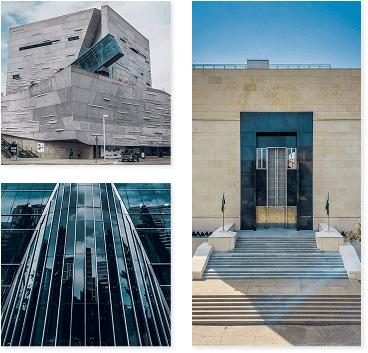



KPost Company fabricates and installs architectural metal panels and cladding for commercial buildings across Dallas Fort Worth, through the same custom sheet metal fabrication shop that produces our edge metal, copings, and custom copper. Interior and exterior wall panel systems are both in scope.
Because we form the panels and install them with our own crews, the panel and the detail around it are a single responsibility. On cladding that is the part that matters, since almost nothing fails in the middle of a panel.

Key Takeaways
- Panel choice is decided by flatness, span, weight, and fire rating. Not by cost alone. Aluminum plate holds a flat face on large panels, aluminum composite material gives the flattest surface at the lowest weight, and steel takes tighter bends for less money at more weight.
- Fire compliance on composite panels is an assembly question, not a product question. NFPA 285 is an assembly test rather than a component test, so a panel cannot be compliant by itself. The IBC requires it for metal composite material on Type I through IV construction, with exceptions that turn on building height, fire separation distance, and how much of the wall the panel covers.
- The joint is the detail that decides whether a wall leaks. A rainscreen system accepts that water gets behind the panel and drains it. A wet-sealed joint relies on sealant as the waterline, which means it relies on maintenance. Which approach a project uses should be settled in design rather than resolved on site.
- Panels move, so the attachment has to let them. A panel on a Dallas wall expands and contracts through a long summer. Attachment that pins a panel rigidly transfers that movement into the fastener or into the joint, and the failure shows up years later.
- Fabricating and installing with the same company removes the handoff. Our panels are formed in an ANSI/SPRI ES-1 compliant shop and installed by our own metal crews, so a dimension that is wrong on site gets a corrected piece rather than a change order and a lead time.