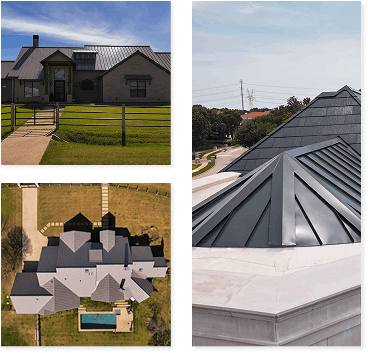
Standing Seam Metal Roofing in Dallas
A standing seam roof is defined by how it is held down. Panels run from eave to ridge and lock together at raised vertical seams, and each panel attaches to concealed clips underneath rather than being screwed through its face. There are no exposed fasteners in the field of the roof, so there are no rubber washers sitting in the sun waiting to fail.
That matters in North Texas for a specific reason. A metal panel on a Dallas roof moves measurably between a January night and an August afternoon, and the clip system is what lets it move without buckling or working its own fastener holes open. A metal roof that leaks almost always leaks at a fastener or a termination, not in the middle of a panel.
KPost Company has installed metal roofing in Dallas Fort Worth since 2004, and our sheet metal work is handled by specialized crews rather than general roofing crews. Panels for larger scopes are formed in our ANSI/SPRI ES-1 compliant sheet metal shop or on site when a run is too long to ship, and we have produced specialized roof panels up to 200 feet.
Key Takeaways
- The clips are the system, not the panel. Standing seam panels attach to concealed clips that let each panel slide as it expands and contracts. Nothing is face fastened through the panel in the field, which is why there are no exposed fastener gaskets to dry out and leak on a 20 year horizon.
- Seam type decides minimum slope. Snap-lock profiles are generally held to a 3:12 minimum. Mechanically seamed profiles, where a seaming machine folds the seam closed on the roof, go lower and are what low-slope and curved work calls for.
- Finish matters more than color for how the roof looks in ten years. A PVDF finish, sold as Kynar 500 or Hylar 5000, holds color and gloss far better than the cheaper polyester finishes under Texas sun. The finish warranty is a separate document from the panel warranty and is worth reading for its chalk and fade limits.
- Gauge buys flatness, not just strength. Heavier gauge holds a straighter line over a long run, resists oil canning and denting, and is more forgiving of the thermal movement a long panel sees between a January night and an August afternoon. 24 gauge is the common standard, with 22 gauge used where spans or appearance demand it.
- Cool roof performance comes from the color, not from the metal. Solar Reflectance Index on a PVDF-coated panel can range from roughly 80 on a solar white to around 30 on a medium bronze. If lowering summer cooling load is a goal, the color selection is where that is won or lost.