

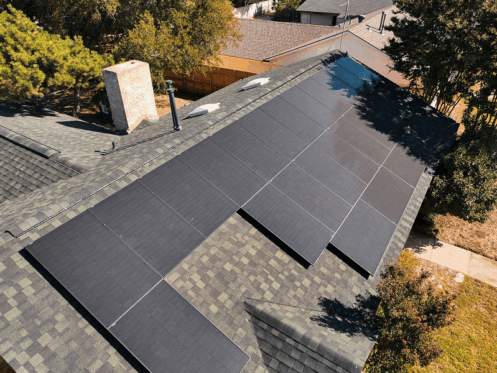
Key Takeaways
- Dallas averages about 230 sunny or partly sunny days a year. That output advantage is why solar economics work here and struggle in places like the Pacific Northwest. Mild winters and limited cloud cover also keep production more consistent across the calendar.
- Most systems pay for themselves in six to 12 years. With Texas electricity averaging around 16 cents per kilowatt-hour, a system that covers most of a household’s daily use commonly cuts the bill in half or better. Across a 25-year lifespan, total savings can exceed $100,000.
- South is the default, but not always the answer. Panels perform best on a south, west, or east-facing slope. Where shading from trees or nearby buildings affects the south face, an east or west orientation can outproduce it by catching more direct sun through the day.
- Roof condition affects the investment, not the output. A worn roof does not reduce how much power the panels make. It does mean paying to remove and reinstall the array when the roof is replaced, which is why replacing first is the cheaper sequence when the roof is near the end of its life.
- Batteries let you arbitrage peak rates. Beyond backup power, storage lets you bank solar production during off-peak hours and draw on it when the utility charges more. That matters most when your provider’s buyback rate for exported power is unattractive.
With the cost of solar panels dropping in recent years, many homeowners are wondering whether going solar is really worth it.
Solar panels allow you to generate your own electricity, dramatically reducing your monthly energy bills. Most systems pay for themselves in six to 12 years, and the long-term savings can be substantial. That said, your actual savings depend on several factors. Here’s what you need to know to estimate your potential return.
Location and Climate
Your location and climate are two of the most important factors in the amount of power your solar panels can produce. In places with frequent cloud cover, like the Pacific Northwest, solar panels may not be as cost-effective. Here in the Dallas area, we average about 230 sunny or partially sunny days per year. That’s a big advantage. Our mild winters and minimal cloud cover also help ensure consistent solar output throughout the year.
Electricity Rates and System Size
The cost of electricity and the size of your solar system directly impact your savings. In Texas, the average rate is about $.16 per kilowatt-hour (kWh). The more electricity you offset from the grid, the more you save. If your solar system covers all or most of your daily energy needs, it’s common to cut your electric bills in half or more. Over 25-year lifespan, your savings could exceed $100,000.
Roof Pitch and Panel Placement
Not all roofs are ideal for solar. For best performance, panels should be installed on a south, west, or east -facing slope.
Shading from trees or nearby buildings can also limit output. In some cases, an east- or west facing orientation may actually yield better performance than south if those sides get more direct sunlight throughout the day.
Roof Condition
While roof condition doesn’t impact energy production, it does affect your overall investment. If your roof is nearing the end of its lifespan, we strongly recommend replacing it before going solar. This helps you avoid the cost and hassle of removing and reinstalling panels later on.
Net Metering and Solar Battery Storage
Texas offers net metering. These programs compensate you for the excess electricity your system sends back to the grid, either with credits or cash. While buyback rates are often lower than standard rates, they still boost your overall savings.
If your provider doesn’t offer an attractive solar buyback program and you are interested in having backup power, adding battery storage can be a smart move. Batteries let you store excess power for use later, even at night or during outages. Although batteries add to your upfront cost, they can help you maximize your solar investment, especially if you’re aiming for energy independence.
You can also use battery storage to strategically manage your power use. For example, if your utility charges more during peak hours, you can store solar power during off-peak times and use it later to avoid higher rates.
Ready to Explore Solar?
If you’re thinking about installing solar panels, KPost Company is here to guide you through every step. We’ve been serving the Dallas area with professional solar and roofing solutions since 2004. Whether you’re interested in traditional solar panels or Tesla Solar Roof systems, we’ll design the right solution for your home or business—and your budget.
Contact us today to schedule a consultation and find out how much you could save with solar.
FAQs
The savings numbers below are easier to picture once you have seen where they come from, so here is what production tracking looks like day to day in the Tesla app:

