

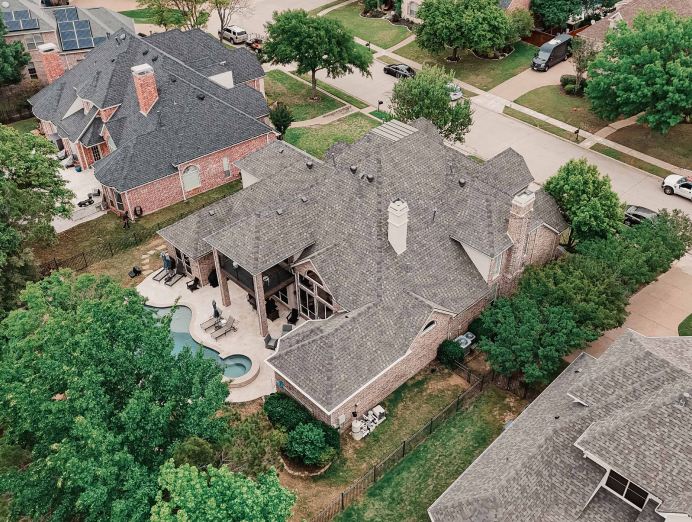
Key Takeaways
- Valleys leak first because everything drains through them. A valley is the internal angle where two roof areas meet, and it carries more water than any other part of the roof. Closed valleys are covered with shingles or the primary roofing material. Open valleys rely on flashing and a water shield instead.
- The field of the roof stops before the perimeter. It’s the area where decking, underlayment, shingles, and tiles get installed, but the term specifically excludes the perimeter and doesn’t include flashing. That distinction matters when you’re reading an estimate or a scope of work.
- Hip, ridge, rake, and gable end describe four different edges. The ridge runs horizontally across the top where two slopes meet. A hip is the external angle where two sloped planes intersect. The rake is the sloped edge at the first and last rafters. The gable end is the triangular section beneath the ridge.
- Eaves protect the walls, but only if the gutters line up. Eaves extend past the supporting wall so water falls clear of siding and windows, and they shade the house from some direct sun. Misaligned gutters undo that, sending rain against the walls or pooling it around the foundation.
- Soffits do two jobs at once. They enclose the underside of the eaves to keep water, pests, and wildlife out of the attic, and perforated panels feed the ventilation system. Clogged gutters and animals are the two things that most often damage them.
The roof on your Dallas home needs to stay in good condition in order to protect you from the elements. Knowing more about the different components of a roof can help you understand how they work together. This information can also help you appreciate how important prompt repairs and maintenance are for your roof.
A. Valley
The valley of your roof is the angle formed internally where areas of your roof intersect. These are the areas where rain tends to run off. Valleys are more prone to develop leaks due to the amount of water that runs through them. Closed valleys have shingles or another type of primary roofing material over them. Open valleys typically have protection from the elements in other ways, such as with flashing and a water shield.
B. Underlayment
Underlayment refers to the material between the covering and deck of your roof. This material is waterproof or water-resistant in order to protect your roof and home from water damage. Underlayments can be waterproof, such as a stone coated leak barrier, or water-resistant, such as felt underlayments. Some underlayments, such as synthetic ones, also resist damage from the sun’s UV rays.
C. Ridge
The ridge of your roof is the horizontal area running along the top of it. This is the area where both sides of sloped roof areas meet. While the ridge refers to your roof’s highest point, it is also the beams and boards used to create this part of your roof.
D. Field of Roof
The field of your roof is the area where most components of your roof are installed. This includes decking, underlayment, shingles, tiles, and other materials. However, the field of your roof does not extend to the perimeter or include the flashing.
E. Field of Roof
Your roof’s batten is the cover or cap set in or over the structural deck.
F. Hip
The hip of your roof is the inclined angles formed externally where two sloped roof planes meet or intersect. Hipped roofs are designed to allow water to run off of them easily, lowering the risk of water damage. These types of roofs also provide additional attic ventilation compared to flat roofs and roofs with other designs.
G & H. Hip Tile/Shingles
Hip tiles or shingles cover the hip of your roof. These tiles are carefully shaped to fit over the hip without leaving any openings where water can get through. An improper fit can result in serious water damage.
I. Soffit
The soffit is the underside of roof sections where they overhanging the eaves. Soffits are enclosed to help prevent water damage and keep pests and wildlife out. They also play an important role in making sure your roof has proper ventilation. Soffits can develop certain issues, such as damage from clogged gutters or wildlife.
J. Rake
The rake refers to sloped edges on your roof next to or at the first and last rafters. With some roofs, rakes overhang gable ends the same as eaves do. With other roofs, rakes are flat and do not overhang the gable ends. Rakes can also be overhanging and exposed rather than closed with a soffit, although these are more often used on sheds or similar structures.
K. Gable End
The gable end refers to the triangular endpoint on the ridge of your roof.
L. Eaves
Roof eaves are the edges sticking out or extending past the supporting wall. Your roof needs these eaves to keep water from pouring onto walls and windows. Roof eaves can also help block some of the sun’s rays, which can keep your home cooler in summer. It’s important to ensure eaves are aligned properly with your gutters to prevent rain from collecting around your foundation or hitting the sides of your home.
When To Service Each Roof Component
Knowing what your roof is made of is step one. Step two is timing maintenance so components last. Have a pro check penetrations and step flashing before storm season, make sure intake and exhaust ventilation are balanced to reduce summer heat load, and verify underlayment performance at eaves and valleys. For complete care that includes inspection, small fixes, and documentation, see our residential roofing services.
Planning a replacement? Material choice affects component selection. Shingle systems often pair well with synthetic underlayments and starter strips, while metal systems rely on clips, high-temp underlayments, and custom trim. Compare profiles and accessory packages on synthetic shingles and tiles or explore stone-long aesthetics on slate roofing. Matching accessories, ventilation, and flashing methods to the primary material is how you get a roof that performs in Texas heat and during fast-moving storms.
When you’re having problems with any of the components of your roof or if you need routine maintenance, please contact KPost Company in Dallas.
FAQs

