

Key Takeaways
- Polyiso lead times went from three or four weeks to eight or ten weeks in about 45 days. The cause is a chemical shortage several steps upstream of roofing, so it hit every major manufacturer at once. Announced polyiso price increases of 5% to 7% took effect earlier in 2026, before lead times moved.
- One plant going offline was enough to move the entire market. Covestro declared force majeure on all of its North American MDI on May 19, 2026, covering its Baytown plant east of Houston at roughly 320,000 metric tons a year. Because a handful of producers hold more than 95% of North American MDI capacity, there was no spare volume anywhere to absorb it.
- Roof insulation now has to be released eight to ten weeks before dry-in. That moves the insulation purchase order well ahead of when a roofing subcontractor would normally mobilize. On fast-track work it becomes a critical path milestone rather than a procurement detail.
- A confirmed purchase order is no longer a confirmed delivery date. Under allocation, manufacturers ration by how much each customer has bought historically, and orders can be trimmed or split after they are acknowledged. Releasing early is what holds a place in the queue.
- The workarounds that actually help involve switching chemistry rather than switching brands. Lightweight insulating concrete and EPS-based assemblies sit outside the MDI constraint entirely. Both change the assembly and both need design team approval, which is why they are worth pricing before a schedule is already in trouble.
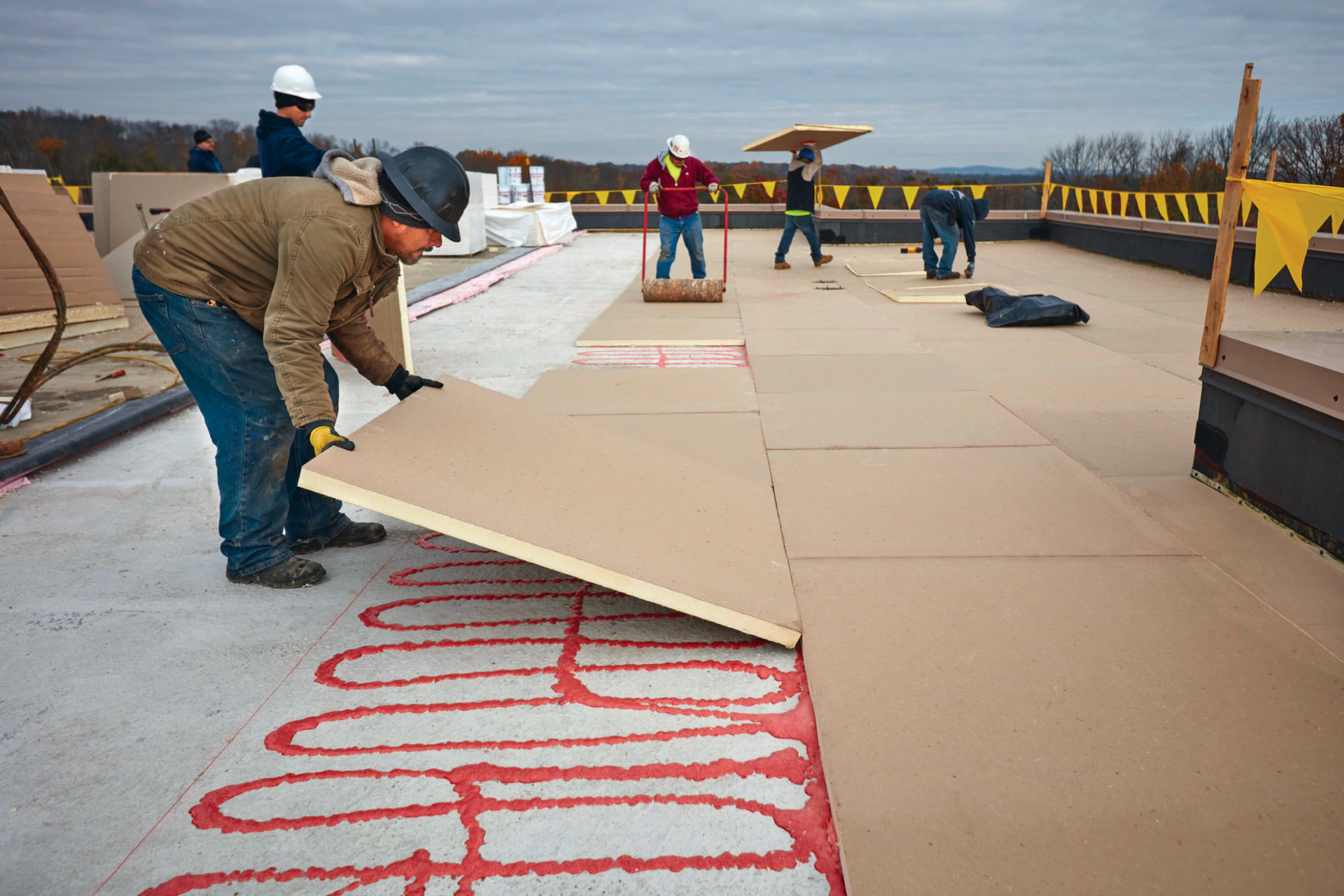
Polyisocyanurate roof insulation, the rigid foam board that sits under most commercial roofs, moved from a three to four week order to an eight to ten week order in roughly 45 days. Announced price increases of 5% to 7% landed on top of that.
Nothing broke inside roofing. The shortage started several steps upstream, at the chemical plants that make one of polyiso’s main ingredients. That distinction is the whole story, because it explains why calling a different manufacturer does not fix the problem, and why relief is unlikely to show up quickly. Below is what happened and what a project team can actually do about it.
What happened to polyiso supply
Polyiso is made from MDI, a petrochemical that only a small number of plants in North America produce. On 19 May 2026, Covestro declared force majeure on all of its North American MDI grades. Force majeure is the formal notice a supplier gives when something outside its control prevents it from meeting its contracts.
The site behind that declaration is Covestro’s plant in Baytown, just east of Houston. At roughly 320,000 metric tons a year, it is the largest MDI facility in the country. The cause sat one level further upstream still. Carbon monoxide and chlorine, both of which MDI production consumes, were not available on the Gulf Coast at the rates the plants need.
Then the timing compounded it. Huntsman’s Geismar plant in Louisiana was in a planned turnaround during the same window, and Dow reported carbon monoxide shortages of its own. Insulation manufacturers went on allocation, meaning they began rationing what they had rather than selling freely. Lead times doubled. Prices followed.
How the market got here
February 28, 2026. Military strikes on Iran by the United States and Israel led to the effective closure of the Strait of Hormuz. Naphtha and other petrochemical feedstocks stopped moving, producers across Asia began declaring force majeure and cutting operating rates, and energy costs reset upward worldwide.
April and May 2026. Polyiso price increases started landing. Hunter Panels announced 5% to 7% on polyiso products effective 13 April. DuPont followed with 6% on Thermax and Tuff-R effective 6 May. Lead times were still normal at this stage.
19 May 2026. Covestro declared force majeure on all North American MDI grades, covering Baytown.
June 2026. Baytown stayed down while Geismar was in turnaround and Dow worked through its own feedstock problems. With capacity that concentrated, three constraints at once left effectively no spot market. Distributors moved to protect contract customers, and open market tons largely disappeared.
July and August 2026. Polyiso manufacturers went on allocation and quoted lead times moved from three or four weeks to eight or ten weeks across all the major roofing manufacturers. Analysts projected further MDI increases through the third quarter and expected global supply to stay tight into 2027.
Why polyiso supply is not recovering quickly
There are only a handful of MDI plants in North America
North American MDI comes from a very short list of facilities. When one of them stops, there is no deep bench to absorb the volume, which is why a single force majeure moved the entire roofing insulation market inside of 45 days. It also means the recovery will not be gradual. The market stays tight until specific plants come back to full rates.
The constraint also sits above the roofing industry, not inside it. Every polyiso producer buys MDI from the same limited pool, so switching brands moves an order to the back of a different queue without adding a single board to the market.
Roofing competes with much larger industries for the same chemical
Roofing does not have its own MDI supply. Every pound that goes into a polyiso board is a pound that did not go into a mattress, a car seat, a refrigerator cabinet, or a sheet of OSB.
Global MDI consumption ran about 8.5 million metric tons in 2024. Construction insulation was the largest block at roughly 4.2 million tons, though that figure covers spray foam, metal composite wall panels, and cold-storage and appliance foam as well. Commercial roof boardstock is a slice of that slice. Automotive took around 1.6 million tons for seating, headliners, and structural foam, on contracts feeding assembly lines that stop without material, which is why producers protect those accounts first. Furniture and bedding took about 1.2 million tons and has been growing.
Polyiso is also unusually MDI intensive. More than half of the board’s formulation is MDI by weight. And polyiso is anything but niche in commercial roofing: PIMA reports it accounts for over 60% of the insulation used in new roof construction and at least 40% in re-roofing. So commercial roofing is one of the most MDI-dependent buyers in the economy and, on a chemical producer’s order book, a modest one. In an allocation market that is the worst combination to hold.
Demand is at a record, and Texas is at the center of it
Mission-critical construction is absorbing enormous volumes of commercial roofing material. Texas data center investment is running around $26 billion in 2026, up roughly 63%, with more than 250 projects planned or underway and about 140 already in active construction. Dallas Fort Worth moved up to the third-largest data center market in North America in the first quarter of 2026. Tight supply is meeting the strongest demand this market has ever seen, and North Texas is where the two collide. We wrote about what that construction wave asks of a roof in our post on commercial roofing for data centers.
What this means for your project
The table below maps where the exposure actually lands. Most of it is schedule and procurement rather than installation.
| Area | Exposure | What to expect |
|---|---|---|
| Schedule | High | Roof insulation has to be released eight to ten weeks before dry-in instead of three to four. On fast-track work the release date becomes a critical path milestone that sits well ahead of the roofing subcontract’s usual mobilization window. |
| Pricing | High | Increases of 5% to 7% are already in effect and further MDI-driven increases were forecast through the third quarter. Quote validity from manufacturers and distributors has shortened, often to 15 or 30 days rather than the customary 60 to 90. |
| Allocation risk | High | Manufacturers ration by historical purchase volume, so orders can be trimmed or split after they are acknowledged. A confirmed purchase order no longer carries the same guarantee of a delivery date that it did six months ago. |
| Tapered systems | Elevated | Tapered polyiso is cut to order and is the longest pole in the tent. Tapered packages need earlier design finalization, and a late drain relocation or slope revision now costs far more in schedule than it used to. |
| Storage and logistics | Elevated | Earlier releases mean material can land before the deck is ready. Protected laydown or offsite warehousing, along with stored-material billing terms, should be settled up front rather than when the truck arrives. |
| Warranty and approvals | Elevated | Any substitution has to stay inside the manufacturer’s approved assembly to preserve the no-dollar-limit warranty and the FM and UL wind and fire listings. That re-approval is a real submittal cycle and belongs in the schedule. |
| Adhesives and accessories | Watch | Low-rise foam adhesives and some single-ply accessories share the same isocyanate chemistry. Tracking these alongside board stock keeps a secondary shortage from undoing an insulation workaround. |
Options that keep a project moving
These are ranked roughly by how much schedule they buy back. Every one of them needs design team concurrence, so they belong in a conversation rather than in a unilateral substitution.
| Option | How it helps | What to weigh |
|---|---|---|
| Lightweight insulating concrete KPost self-performs |
Removes polyiso from the assembly entirely. LWIC uses EPS board inserts, which are polystyrene chemistry with no MDI exposure, encapsulated in insulating concrete that forms slope monolithically instead of through cut-and-stack tapered board. Assemblies carry FM and UL wind-uplift and fire ratings and have typically priced $2 to $4 per square foot below tapered polyiso. | Requires a compatible deck, meaning steel deck with the correct venting or structural concrete, plus a structural check for the added dead load. It needs cure and dry-down time before the membrane goes on, which moves schedule risk out of procurement and into sequencing. It is a design change and needs architect and engineer approval. |
| EPS-based or hybrid assemblies | EPS and XPS are polystyrene based and therefore sit outside the MDI constraint. A hybrid using EPS base layers under a thin polyiso or gypsum coverboard sharply reduces the polyiso quantity while keeping a familiar assembly. | EPS delivers roughly R-4 per inch against polyiso’s R-5 to R-6, so total thickness grows to hold the same R-value. That cascades into parapet heights, curb and equipment rail heights, door thresholds, edge metal, and flashing details. Code R-value compliance and the manufacturer’s approved assembly both need to be confirmed. |
| Early release and buyout | The single highest-value move available. Releasing insulation at contract award, ahead of the usual submittal-then-order sequence, establishes a place in the allocation queue and locks pricing before the next announced increase. | Requires early purchase order authority and, critically, payment for stored materials. Without that, the contractor funds the project’s schedule protection out of pocket. It also locks quantities before final design in some cases, so a takeoff contingency is prudent. |
| Design to availability | Where the specification allows, the assembly gets reconfigured around what is actually shipping: common thicknesses instead of odd ones, flat board plus tapered crickets instead of a fully tapered field, and a thicker high-R coverboard to make up thermal performance. | Needs an or equal path or a formal substitution procedure. R-value and assembly listing have to be re-verified. Some reconfigurations trade material availability for added labor. |
| Re-sequencing | Phasing the roof by building or by area so dry-in follows material as it lands, rather than idling a crew waiting on a full package. | More mobilizations and more temporary protection scope. This works best when it is identified early, while the overall schedule still has room to absorb it. |
This is not the first time this playbook has been needed. During the 2021 and 2022 supply chain crisis, KPost pivoted several new construction projects from specified polyiso assemblies to self-performed lightweight insulating concrete and held the construction schedule. The conditions were different then, tracing to Winter Storm Uri and pandemic logistics rather than feedstock chemistry, but the approach is the same and it has been proven on our own crews.
What KPost is doing about it
- Ordering at award rather than at submittal approval. On every new contract we release insulation as early as the documents permit, to hold a position in the allocation queue.
- Working manufacturer relationships directly. Allocation is granted on purchase history, so our purchase history is what gets us served. We work it project by project instead of letting an order sit in a distributor queue.
- Tracking real lead times weekly, by manufacturer and by product. Quoted lead times and actual ship dates have diverged. We plan against the second one.
- Carrying multiple approved paths on every bid. Where the specification permits, we price and pre-qualify an alternate assembly at bid time so a pivot becomes a decision rather than a redesign.
- Flagging escalation exposure up front. When a quote window is shorter than the buyout schedule, we say so at the time of bid instead of bringing it later as a change order.
- Keeping our LWIC capacity available. Self-performed crews mean the alternative is one we can actually schedule, not one that depends on another shortage-era subcontractor.
Frequently asked questions
Bring us the roof scope early
The earlier a roof scope gets looked at, even at design development, the more options are still open. We can tell you what is actually available and what it costs today, and if it is not available, what the alternate looks like. That conversation is far cheaper in design development than it is after a release date has already been missed.
KPost Company has handled commercial roofing and building envelope work across Dallas Fort Worth since 2004, including AT&T Stadium and Globe Life Field. If you have a commercial roof installation in design or in preconstruction right now, contact our team and we will walk the material picture with you.
Market conditions described here reflect published industry reporting and KPost’s quoted lead times as of September 2026, and they are changing. Lead times, pricing, and allocation status are subject to manufacturer confirmation at the time of order and do not constitute a quotation or a guarantee of availability. Product substitutions, assembly modifications, and R-value compliance require review and approval by the project’s design professionals and the roofing system manufacturer.

