
Key Takeaways
- Minimal roof penetrations is the entire design goal. Charlie Krauss, KPost’s Roofing Deck Manager, puts it plainly: a data center roof needs as few penetrations as possible, because every one is a potential leak. Alongside security and power management, controlling moisture through the building envelope is among the highest priorities in running a data center.
- LWIC removes fasteners from the deck entirely. Steve Little, KPost’s President, notes that the system eliminates through-deck fasteners, which removes the most common leak path. Dropping fasteners, adhesives, and Polyiso also cuts insulation costs by up to 30%.
- Sloping to the perimeter eliminates roof drains. Building slope into the deck sends water off the outside edge instead of through interior drains, which removes another set of penetrations from the assembly. Rigid systems offer far less flexibility to shape slope this way.
- Reroofing happens without shutting anything down. There’s no tear-off, so the existing roof stays in place and operations continue underneath. Nothing goes to a landfill, and the systems carry 20-year warranties while costing less than a rigid product installation.
- KPost has done this on named facilities. Completed data center projects include CyrusOne, T5, the SMU Data Center, 3000 Skyline, and Bank of America. Most data centers are retrofits of existing infrastructure rather than ground-up builds, which is exactly where a no-tear-off system fits.
With the continuing saga of the Target security breach, it’s no wonder that security is top of mind for businesses and consumers alike. Most recently, the Department of Justice announced they are investigating the Target data breach, while the Target internal investigation yields a stolen vendor’s credentials as the source of the access. Target has chosen to be very transparent about the breach, offering not only apologies but a free subscription for credit monitoring to those impacted. Choosing to invest in security is no small task, and one of the reasons that data centers are becoming more prevalent.
Data centers offer levels of security that many companies cannot reach on their own. Coupled with the popularity of cloud applications, data centers are cropping up more frequently, particularly in the North Texas area.
The majority of data centers are not built from the ground up. In fact, taking over existing infrastructure and then retrofitting is not only more cost effective, but allows the data center to be placed on the right real estate, rather than trying to build on the outskirts of a city or inside new developments. Data centers require specialized power support, such as being on a section of the grid that has higher priority or investing in multiple generators, as well as excess cooling so a top of the line HVAC system is important. Specialized fire control systems are needed so that there is no water sprayed on the sensitive equipment. Water is the nemesis of a data center. This is where commercial roofing for data centers plays a large role.
“Data centers are a little different in that we need to install a roofing system that has minimal penetrations, thereby minimizing the chance of leaks,” said Charlie Krauss, KPost Company Roofing Deck Manager. “Besides security and power management, controlling moisture penetration of the building envelope is one of the highest priorities of managing a data center.”
Lightweight Insulating Concrete for Data Centers
Using lightweight insulating concrete (LWIC) supports the specialized needs of data center reroofing. “The LWIC system eliminates fasteners thru the deck therefore minimizing roof penetrations so there are fewer places for leaks to occur. In addition, the elimination of fasteners, adhesives, and Polyiso reduces insulation costs up to 30% while still constructing to slope to the outside perimeter, which eliminates roof drains ensuring that water runs off the roof as desired,” stated Steve Little, KPost Company President. ”LWIC systems promote green construction and reduce future costs of reroofing, as well as eliminate unnecessary dumping in landfills and protect our carbon footprint.”
“To get the water off the roof, it is important to consider the product as well as the design of the system. This is where value engineering comes into play,” said Krauss. “In lieu of a design that incorporates rigid installations, we use LWIC to allow for more flexibility in providing different slopes. Then we can be sure that the roof is water tight.”
LWIC provides multiple benefits for data center installations, including:
- No tear offs – leaving the existing roof minimizes damage
- 20 year warranties
- Less expensive than a rigid product installation
- Minimal penetrations, minimizing opportunities for leaks
- Reroofing allows other work to continue – no disruption of existing operations
KPost Company has excellent experience in commercial roofing of data centers, having completed multiple projects including the CyrusOne Data Center, T5 Data Center, SMU Data Center, 3000 Skyline Data Center and Bank of America.
“Our work in the data center industry, especially using LWIC, is a proven game changer. LWIC allows us to offer a product that is environmentally friendly and economical, while exceeding the watertight building envelope conditions required by our customers,” said Steve Little. “Our understanding of the best materials for the job ensures that the data center can be up and running quickly without the worry of a leaky roof.”
FAQs
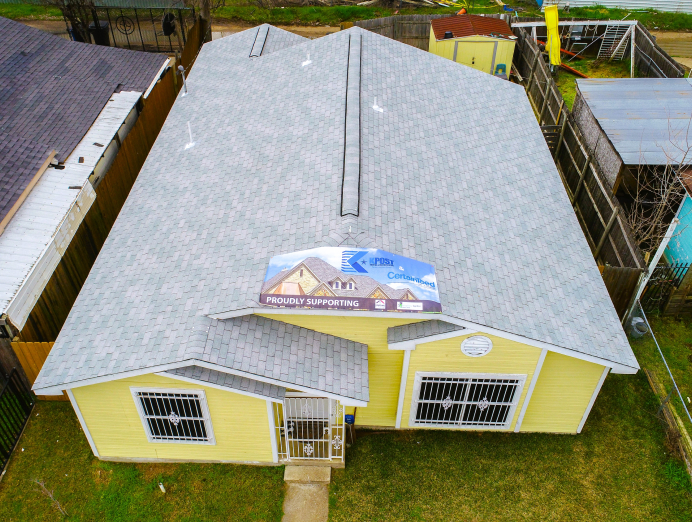
Facilities with sensitive equipment cannot tolerate water intrusion, and this TPO recover at the UNT Science Research Building shows how we work over an occupied building:

