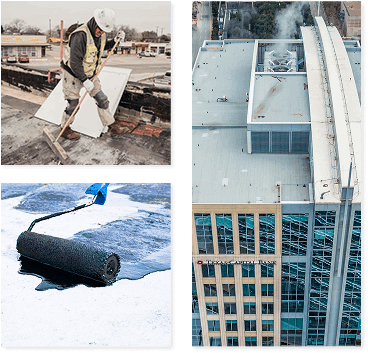
What Is an Elastomeric Wall Coating?
An elastomeric wall coating is a flexible film that stretches as the wall moves and returns to shape afterward. It goes on several times thicker than exterior paint, usually in two coats, and the combination of thickness and stretch is what lets it bridge hairline cracks and hold up against wind-driven rain. Paint adds color. A coating built to its specified thickness becomes part of how the wall keeps water out.
Stretch is only half of it. A coating also has to recover after it stretches, season after season, or it stays deformed over the crack until it splits. An article in the International Concrete Repair Institute’s bulletin rates recovery above 95 percent as excellent and puts typical thermal crack movement at a few thousandths of an inch. Cracks that move more than that may be structural. They are routed and sealed, or looked at by an engineer, before any coating goes on.
Wall coatings are also different from the roof and deck products sold under similar names. They aren’t made to take foot traffic, so balconies and walkways get a deck coating system instead, and roof coatings are built for a different surface and a different exposure.
How the Wall Coating Options Compare
Four kinds of product get called wall coatings. They do different jobs, and which one fits depends on what the wall is made of and what it has to resist. The chemistries used on roofs and decks are compared in our waterproofing coatings guide.
| Product |
What it does |
Where it fits |
Watch for |
| Elastomeric wall coating |
A thick, flexible film, usually applied in two coats, that stretches over hairline cracks and sheds wind-driven rain. Vapor-permeable versions let moisture out of the wall |
Concrete block, tilt-wall panels, poured concrete and stucco, including walls with fine cracking |
Needs a clean, dry surface. Textured versions stretch less than smooth ones, and no coating bridges a crack that keeps opening |
| High-build waterproof coating |
A thick, firm film that protects the surface and gives it a uniform finish, with less stretch than an elastomeric |
Monolithic concrete and masonry walls that are not cracking |
Bridges less cracking than an elastomeric, so cracks are repaired before it goes on |
| Exterior paint |
A thin film that adds color and some protection from sunlight |
Walls that already keep water out and only need a new finish |
Too thin to bridge cracks or hold back wind-driven rain on its own |
| Clear penetrating repellent |
A silane or siloxane that soaks into the surface and makes it shed water, with little change to its look |
Brick, along with architectural concrete that has to keep its appearance |
Won’t stop water coming through cracks or failed joints, and it has to be renewed as it wears off |
Which Walls Get Which Coating
The wall’s material sets both the product and the preparation.
- Concrete block. Block is porous, so a block filler goes on first to close up the face. The elastomeric goes over the filler.
- Tilt-wall panels. Smooth panels are cast against a bond breaker and often cured with a curing compound, and residue from either can keep a coating from bonding. The Painting Contractors Association’s standard for painting vertical concrete notes a long record of failures on it and treats removing that residue as outside the painter’s scope, so the contract should say who does it.
- Stucco. Stucco is a portland cement product, and some cracking is expected even on a well-installed wall. Manufacturers point elastomeric coatings at stucco for that reason, since they stretch over fine cracks. Larger cracks are repaired before the wall is coated.
- EIFS. An elastomeric coating can renew a worn EIFS finish, but it can change the texture and vapor permeability of the original surface. EIFS manufacturers typically make coatings designed for their own systems, and compatibility with the existing finish is checked with an ASTM D3359 tape test. The EIFS industry’s renovation guidance starts with a call to the system’s manufacturer.
- Brick. These walls usually shouldn’t get a film. The Brick Industry Association advises against film-forming coatings on brickwork exposed to freeze-thaw cycles, and a clear penetrating repellent is the usual treatment where one is needed.
Why Breathability Matters on a Coated Wall
Some water gets into every wall, through a joint or as vapor from inside the building. Whether it does damage depends on whether it can get back out. Permeance, measured in perms, describes how easily vapor passes through a material, and a lower number means more resistance. Our air and vapor barrier page lays out how codes classify vapor retarders.
A coating rated under 1 perm acts as a vapor retarder. On the outside of a damp wall it holds moisture behind the film, which is how coatings blister and peel. A film by itself isn’t the problem. A film that won’t let vapor through is, and that is what sits behind the usual warning against film-forming sealers on masonry. Vapor-permeable elastomeric coatings are formulated to stop liquid water while letting vapor pass, and the product data sheet reports the perm rating from a standard test such as ASTM D1653. Check that number before a coating is specified.
Breathable doesn’t mean bare. A second article in the same ICRI bulletin reports that coatings sold as breathable still typically cut vapor transmission by 50 to 90 percent compared with an uncoated surface. That is one more reason the leak gets fixed and the wall dries out first. Manufacturers also set a maximum moisture content for the surface, and the wall should be tested against it before anything is applied.
Weatherproof Above Grade, Not Waterproof Below It
Wall coatings are rated against rain driven by wind. The usual laboratory method, ASTM D6904, sprays coated masonry blocks with water under air pressure equal to a 98 mph wind, typically for 24 hours, and then checks them for leaks and weight gain. The practice sets no minimum score, so a product claim built on it is worth reading closely.
Nothing in that test resembles groundwater pressing against a foundation wall. Below grade, water sits against the wall under constant pressure, and that calls for a below-grade waterproofing system built for it. Elastomeric wall coatings are made for walls above grade.
What Has to Be Fixed Before the Wall Is Coated
Most of the envelope leaks KPost is called about trace back to wall joints, failed sealant, parapets or the terminations where one system meets another. A coating on the face of the wall seals none of them, so these details get repaired first.
- Sealant joints. Joints between tilt-wall panels and around windows are common entry points, and a coating can’t take the movement a joint is designed for. Split or loose sealant is cut out, and the joint gets backer rod and fresh sealant as part of our joint sealing work.
- Window perimeters. The seal between a window frame and the wall ages on its own schedule. Testing at the window shows whether the leak is in the window glazing or coming from above it.
- The top of the wall. A parapet with a failed or missing cap takes water into the wall from above, where no coating on the face can stop it. On one healthcare building we coated in 2025, the scope added a shop-fabricated parapet cap where the wall had none.
- Cracks and spalls. Active cracks are routed and sealed, and spalled concrete is cut back to sound material and patched. That concrete and masonry repair comes before the coating.
- Expansion joints. Joints built to let the building move travel far more than any coating can stretch. They keep their own expansion joint system or sealant rather than relying on the coating.
White efflorescence on masonry shows that water is moving through the wall. A paper on elastomeric coatings presented at the RCI convention notes that it can trace back to a roof or flashing problem that coating the wall won’t fix. When the source isn’t obvious, controlled water testing narrows it down to the component that is failing.
How a Commercial Wall Coating Job Runs
- Find where the water gets in. Stains inside show where water ended up, which is seldom where it entered. Testing at the suspect joints and at the top of the wall confirms the path before a scope is written.
- Repair the wall. Sealant joints, cracks, spalls and the parapet cap are dealt with first, in whatever order the wall needs.
- Clean and check the surface. The wall is washed, and anything that would keep the coating from bonding comes off, from chalking paint to tilt-wall bond breaker. The surface is tested against the manufacturer’s moisture limit, and an adhesion test on a small area shows whether the coating will hold to what’s already there.
- Fill and prime. Porous block gets a block filler. Other surfaces take the primer the coating system calls for.
- Apply the coating to thickness. Most systems go on in two coats. Thickness is the difference between a coating and paint, so it should be checked with a wet film gauge as the work goes. Water-based coatings need a dry forecast, since rain before they cure can damage the film.
- Keep it maintained. Sealant joints and the coating get looked at on a schedule, and the recoat goes into the building’s capital plan.