

Key Takeaways
- Call a roofer first, then file promptly. An inspection tells you what the hail actually damaged before you open a claim, and the Texas Department of Insurance tells homeowners to file as soon as they can.
- Hail damage often cannot be seen from the driveway. On shingles it usually shows up as bruising and lost granules where the stones hit, and a fractured mat underneath may not be visible at all.
- Soft metals record the storm. Dents in gutters, vents, flashing and air conditioner fins show that hail of a given size fell at your address, which helps when the shingle damage is harder to see.
- Metal roofs can carry a cosmetic damage exclusion. If hail dents a metal roof without letting water through, some policies will not pay to fix it. Check your policy before the next storm.
- A roofer can document the damage but cannot negotiate your claim. Texas does not allow a roofer or contractor to act as your public adjuster, and it is illegal for a contractor to waive your deductible.
Hail damage is hard to judge from the ground. Stones big enough to bruise a shingle often break nothing you can see, so the roof keeps shedding water for another season while the bruised areas age several times faster than the rest. Older, brittle shingles bruise at even smaller sizes. So after a hail storm, who should you call first, your insurance company or a roofing company?
Call a Roofing Company First
The first call should be to your roofer. A roofing company can get on the roof safely and find the damage you cannot see from the yard, so you know whether there is anything worth claiming before you open a claim. Once you know, file with your insurer promptly. The Texas Department of Insurance tells homeowners to file as soon as they can, and deadlines vary by policy. Some homeowners policies allow a year, while others expect to hear about water damage much sooner.
If the storm left you with an active leak, temporary protection comes before anything else. Our emergency roof repair crews handle that in Dallas, and the permanent repair follows once the roof is dry and the scope is clear.
What Hail Damage Looks Like on Your Roof
What to look for depends on what your roof is made of. Here is how hail damage shows up on the most common roof types.
Asphalt Shingles
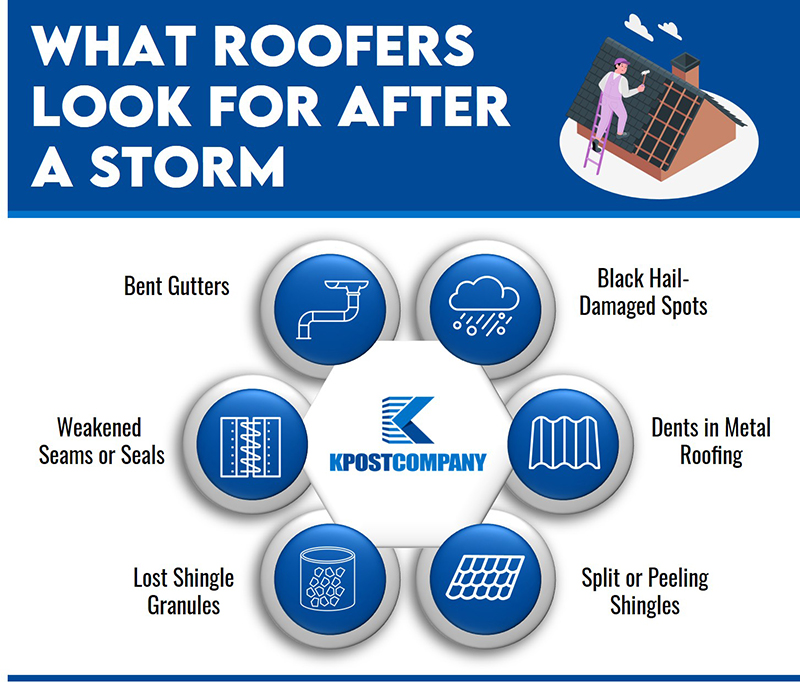
On shingles, a hail hit usually shows up as a dark spot where the granules were knocked loose, sometimes with a slight dent. Pressed with a finger, a bruised spot feels soft, like a bruise on an apple, and harder hits leave cracks that spread out from the point of impact. The damage that matters most is often the hardest to see, because a fractured mat may not be visible at all. Ridge caps tend to take the worst of it. Shingles that are cracked or peeling after a storm are worth having looked at even if nothing is leaking yet, and so are granules collecting in the gutters and downspouts.
Metal Roofs
Large hail can dent metal panels, and the dents are easy to see. Whether they count as damage is another question. A policy that discounts the premium for a metal roof may also carry a cosmetic damage exclusion, which means hail that changes how the roof looks but not how it works will not be paid for. Damage that lets water through the panel, such as a puncture or an opened seam, is a different matter, so the inspection should look closely at the seams and at the flashing.
Tile Roofs
Clay tile generally holds up to small and medium hail, but tile is brittle, and larger stones crack or break individual tiles. A cracked tile usually does not leak right away, because the underlayment below it is the real waterproof layer. That underlayment is now exposed to sun and weather it was never meant to take, though. Tile roofs are better inspected from a ladder and from the attic than walked, since walking on a damaged tile roof breaks more tile. More on our clay and concrete tile page.
Flat and Low-Slope Roofs
On a flat roof, hail can bruise the membrane and crush or fracture the insulation board underneath without leaving a visible hole. The base flashings at walls and curbs usually take damage first, because they are exposed and have less solid support behind them. With so much of it hidden, a proper low-slope inspection means pressing on the membrane to find dented insulation, plus moisture scanning or test cuts where the surface does not tell the whole story. Our commercial roof repair team handles flat roofs on commercial buildings, and our TPO roofing crews cover the flat sections of homes.
What to Do in the First 48 Hours After Hail
The first two days after a storm are when the evidence is freshest and a small leak is easiest to contain.
- Stay off the roof. A wet, storm-damaged roof is a fall risk, and walking it can cause damage of its own.
- Photograph everything. Take pictures and video of the damage inside and out, and make a list. Photos of hailstones next to a coin or a ruler help show how big the hail was. Do not throw damaged items away until your insurance company tells you to.
- Check the attic and ceilings. Wet insulation or a new stain under the slopes that faced the storm means water is already getting in, and roof leak detection can find where.
- Stop more damage. Remove standing water and cover broken windows or holes. Keep every receipt, because your policy may pay for temporary repairs.
- Book a roof inspection. Have a roofer document the damage, then file promptly once you know what you are dealing with.
- Be careful who you sign with. Get more than one estimate, check references, do not pay in full up front, and never sign a contract with blank spaces. Avoid any contractor who offers to waive your deductible, because that is illegal in Texas.
Why a Roofer Should Inspect Before You File a Claim
An adjuster works from evidence, and a roofer’s inspection gives you evidence of your own. We photograph each slope as we go and give you an itemized list of the damaged materials. Dented soft metals go into the record too, because they show that hail of a given size actually fell at your address. Carriers evaluate each slope separately, often by counting hits inside a ten-by-ten-foot test square, so knowing which slopes are damaged before the adjuster arrives keeps the conversation on facts. We can also meet your adjuster at the house.
What a roofer cannot do in Texas is negotiate the claim for you. State law does not allow a roofer or contractor to act as a public insurance adjuster, so if you want someone to represent you on the claim itself, that has to be a licensed public adjuster who is not also doing the work. Our guide to handling a Texas roof insurance claim walks through the rest of the process.
When Hail Damage Means a New Roof
Many hail-damaged roofs can be repaired, and our hail damage roof repair page covers how that works. Replacement becomes the answer when damage reaches enough slopes that spot repairs would not last, or when your shingle has been discontinued and a repair would show. Soft or water-damaged decking found during the work can widen the scope too. Your policy matters here as well. Many Texas policies have moved older roofs onto actual cash value, which pays the replacement cost minus depreciation for the roof’s age and condition, and on a fifteen-year-old roof that difference can be most of the claim.
If you are replacing the roof anyway, price a Class 4 impact-resistant shingle, the top rating in the UL 2218 impact test. Many Texas insurers discount the premium for an impact-resistant roof, and Texas law stops an HOA from prohibiting shingles designed to resist wind and hail, as long as they resemble the shingles allowed in your neighborhood. Our storm damage team documents the roof for the claim and can walk you through the upgrade, and our post on how a new roof can lower your insurance premium covers the discount.
After a hail storm, call your roofer first, then your insurance company. If you are in Dallas-Fort Worth, contact KPost to schedule a storm damage inspection.

