

Key Takeaways
- Blisters are trapped air and moisture that heat expands. Many can simply be watched. Repair the ones that have opened or cracked. A closed blister also needs repair when it sits in a traffic path or is pulling a seam apart.
- Ridges are firm and blisters give. A ridge is a long raised line in the membrane, usually over an insulation or deck joint. NRCA notes it may be a sign of movement within the roof assembly.
- Seams and splits open when the roof cools. A roof expands through the summer and contracts as temperatures fall. A National Bureau of Standards study noted that most complaints about roof splitting come in after extended cold weather.
- The 2026 summer gave DFW roofs a lot to recover from. DFW Airport recorded 52 days at 100 degrees or higher through September 22, against a normal of 20, and went 67 days without measurable rain.
- Seal the roof before the rain and the first freeze. October is normally DFW’s second-wettest month, and the average first freeze is November 22. A fall inspection under a preventative maintenance agreement such as the KPost Advantage Program finds this damage while it is still a repair.
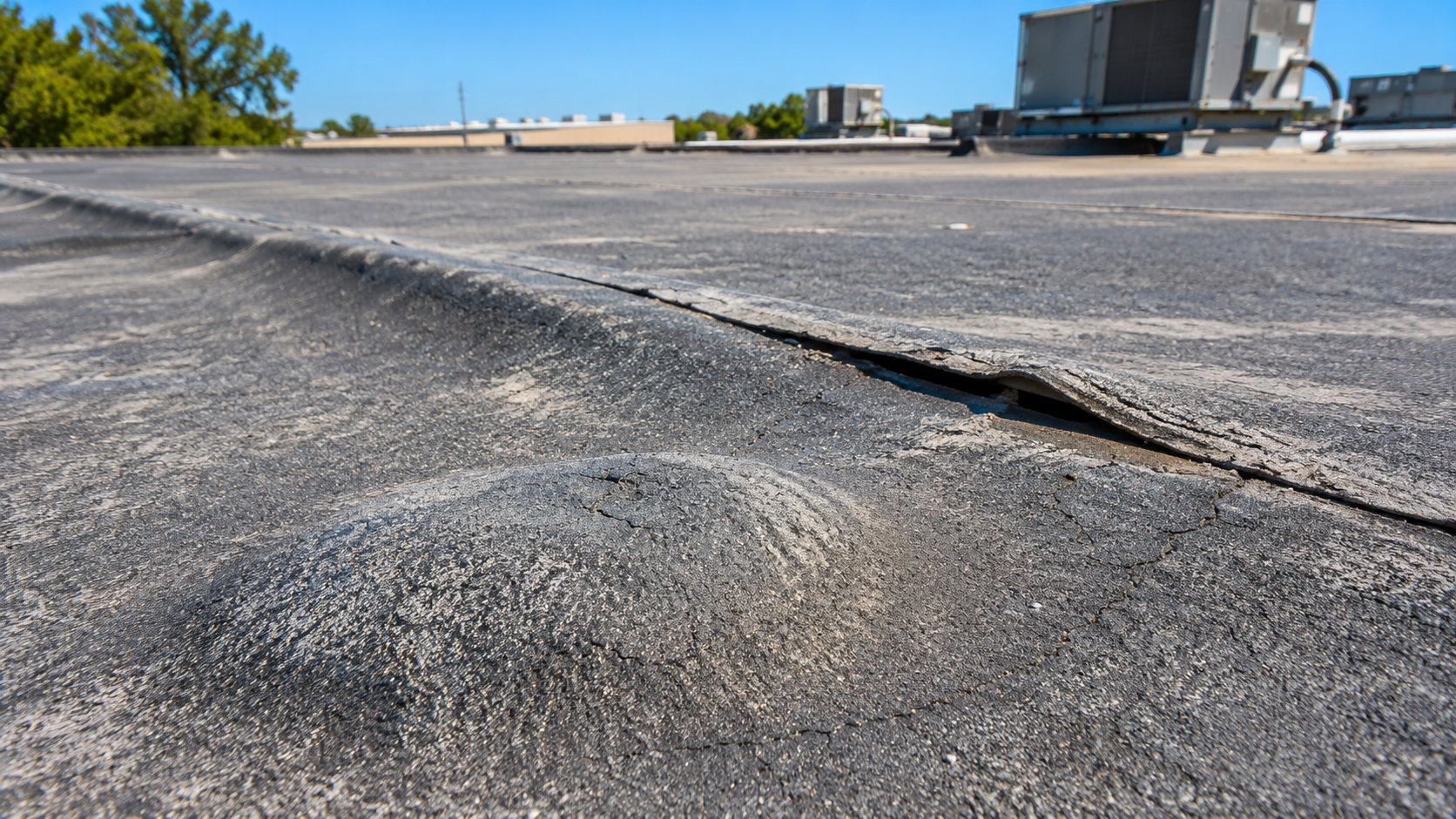
Blisters on a commercial flat roof form when air or moisture trapped between the layers of the roof heats up and expands, pushing the membrane into a raised pocket. A blister that is still closed can often be left alone and watched. One that has ruptured or cracked, or one that is pulling a seam open, needs repair before it lets water in.
Blisters are one of three marks a hot summer leaves on a low-slope roof. Ridging and split seams are the other two, and fall is when all of them show. This post takes each symptom in turn, with its cause and how urgent it is, then covers what to seal before winter.
Why does Texas heat damage show up in the fall?
Because the damage is driven by movement, and the movement reverses when the weather cools. Extreme heat makes a roof expand. Once temperatures drop under 70 degrees the roof may start to contract, and the seams and flashings that were stressed all summer are where that contraction shows first. It needs to be addressed before the winter freeze, because rain and colder weather bring more contraction and worse damage.
The temperature range on a roof is wider than the forecast suggests. In a 1963 National Bureau of Standards study, a black asphalt roof over insulation reached 165 degrees on an August day, about 80 degrees above the air. On clear nights the same kind of surface ran about 20 degrees cooler than the air. The study also found that thermal movement is most critical at low temperatures.
The sudden version has a name. NRCA defines thermal shock as the stress produced by a sudden temperature change in a roof membrane, as when a cold rain shower follows brilliant sunshine.
This year gave DFW roofs plenty to recover from. Dallas Fort Worth International Airport recorded 52 days at 100 degrees or higher through September 22, according to the National Weather Service. The normal is 20. The airport also went 67 days without measurable rain, from July 16 to September 20, which ties the second-longest dry stretch on record there.
Now the swing goes the other way. The normal high at DFW drops from 95.8 degrees in August to 78.4 in October and 66.6 in November. October is normally the second-wettest month of the year, and the average first freeze falls on November 22. KPost founder and CEO Keith Post has put the risk this way: “When you consider the impact of rapid and ongoing heating and cooling of commercial properties due to weather, you must take into account the expansion and contraction of materials, which can create a point of failure.”
What causes blisters on a commercial flat roof?
A blister, or bubble, is a raised section of membrane over a pocket of air, often mixed with water vapor, trapped between the plies or between the membrane and the surface below it. Roof blistering starts at a void or a spot that never bonded. Heat raises the pressure in the pocket and the blister swells. Each night it can draw in a little more air and moisture, so it grows.
Moisture is what makes a blister aggressive. A 2024 article in Professional Roofing, NRCA’s magazine, reported that water vapor is twice as potent inside a blister as dry air. A federal repair procedure from the General Services Administration gives a quick way to tell a blister from a ridge: a blister yields to pressure and a ridge stays firm.
Whether a blister needs commercial roof repair depends on its condition. Published guidance from NRCA and others sorts them this way:
- Leave and monitor: a blister that is closed and intact and sits outside foot traffic. Smaller blisters are generally best left alone.
- Leave and monitor: a blister under an adhered single-ply membrane that is not weathered or cracked.
- Repair: a blister that has ruptured or exposed its reinforcement, or one with fatigue cracks forming around it.
- Repair: a blister in a high-traffic area, even if it is still closed.
- Repair: a blister that has pulled a seam apart by about one-third or more of the seam width.
- Repair: a blister on a built-up or modified bitumen roof that has lost its gravel or granule surfacing.
Blisters that keep appearing across one section carry a different message. They can point to moisture in the assembly, and that is worth confirming with a core sample or a moisture survey before more patches go down.
What causes ridging in a roof membrane?
Ridging is a long, raised line in the membrane, and it usually sits over a joint in the insulation or the deck. NRCA’s glossary treats it as a buckle and notes that it may indicate movement within the roof assembly. Moisture is the other common cause. It distorts the surface under the membrane, and the ridge grows as that trapped moisture vaporizes in the heat.
Repeated expansion and contraction feeds it. Canada’s National Research Council has noted that the plies of a bituminous membrane may slip against each other through successive expansion and contraction, which can promote ridges and leave the membrane more prone to splitting.
A ridge by itself is rarely urgent. It becomes a problem when it interferes with drainage or the roof starts to leak there, and worn surfacing along the crest is the early warning. Until then, measure and photograph it so the next inspection has something to compare against. A ridge that keeps growing means the movement or the moisture underneath has not stopped.
Why do roof seams split and open?
Seams and splits are tension failures. NRCA defines a split as a membrane tear resulting from tensile stresses, and a roof is under the most tension when it contracts in cool weather. The Bureau of Standards findings agreed with field reports that most complaints about roof splitting arrive after extended cold weather. A seam that was welded or glued a little short of right can hold through the summer and let go in the fall.
How it happens depends on the membrane:
- TPO and PVC seams are welded with hot air. A weld made too cold can pass a probe and still detach over time, which is why manufacturer welding guidance calls for test welds several times a day as air and membrane temperatures change.
- EPDM seams are joined with adhesive or tape, and they separate through application errors or adhesive failure. A membrane that has shrunk will also pull tight at the base of a wall, a condition called bridging.
- Built-up and modified bitumen roofs split through the plies or open at the laps, and a blister that grows into a lap can pull it apart.
Any open seam or split is a direct path for water, so this is the symptom that does not wait. The fix is usually local. A patch is the right answer when the membrane around the damage is sound, and that is the everyday work of flat roof repair. Seam separation across the whole field of the roof is different. It points past repair, toward replacement.
What other heat damage should you look for?
Two more symptoms belong on a fall roof walk. Alligatoring is a pattern of cracks in an asphalt surface or a coating that looks like alligator hide. NRCA ties it to aging, as the material loses its volatile oils and oxidizes under the sun. Fastener back-out shows up on mechanically attached roofs as a small raised point under the membrane where a screw has worked loose. Wet or crushed insulation can produce the same bump, so it is worth finding out which one you have.
The table puts all five side by side.
| Symptom | Likely cause | How urgent | Typical repair |
|---|---|---|---|
| Blister | Air or moisture trapped between layers, expanded by heat | Can be monitored while closed and out of traffic. Repair once it ruptures or starts opening a seam | Cut out the blister and patch, following the membrane manufacturer’s method |
| Ridge | Movement at an insulation or deck joint, or moisture distorting the surface below | Monitor. Act when it blocks drainage or leaks. Worn surfacing is the early warning | Restore the surfacing or patch the worn crest |
| Split or open seam | Tension as the roof contracts, acting on a weak weld or failed adhesive | Repair now. It is an open path for water | Clean and prepare the area, then patch or re-seam it |
| Alligatoring | Sun and age drying out an asphalt surface or a coating | Plan for it. The cracks may or may not run through the surfacing | Apply a compatible coating and new surfacing |
| Fastener back-out | Movement and vibration working a fastener loose | Repair now. A raised fastener can puncture the membrane | Set a new fastener in a different spot, then patch the membrane |
Sealant belongs on the same list. Roofing moves with temperature, and a sealant that cannot take the movement at a joint will crack or let go. Our post on roof sealant failure covers the warning signs.
What should be repaired before winter?
Anything that is open. Split and open seams, ruptured blisters, failed sealant at penetrations and raised fasteners all let water into the roof, and they should be sealed before the fall rain and the first freeze. Colder weather brings more contraction, so an opening that is small in October tends to be larger by January.
Water makes it worse in two ways. Rain that gets under the membrane soaks the insulation, and wet insulation is what turns a repair into a larger scope. Water that stands on the roof can freeze, and ice can crack roofing materials and drain components. Clearing the drains and scuppers belongs on the same visit as the seam repairs.
The calendar helps. Early fall is one of the easiest windows for scheduling roof work in DFW, and late fall still works for anything that has to be finished before winter.
How does a maintenance program catch heat damage early?
By putting a trained inspector on the roof on a schedule and keeping a record of what changes between visits. NRCA recommends at least two inspections a year, preferably in spring and fall. KPost recommends the same, and the fall visit is the one that finds what the summer did before the rain arrives.
KPost’s preventative maintenance agreement is called the KPost Advantage Program. On a KPost maintenance inspection, the crew checks the drainage, the seals at rooftop vents and equipment, the flashings and the penetrations, and looks for signs of roof damage. Small cuts and open laps get repaired during the visit. Larger items come back to you as a written proposal, sorted into what has to happen now and what can be scheduled and put in a budget.
That proposal is where a fall inspection and next year’s budget meet. Fall is a good time for budgeting, and the inspection gives the budget real numbers to work with. An earlier KPost post on budgeting for roofing and waterproofing issues makes the same case: inspect proactively and repair on time, and fewer expenses arrive unbudgeted.
Frequently asked questions
Walk the roof before the first freeze
Heat damage found in October is usually a repair. Left through a winter of rain and contraction, it tends to become a bigger one. The window between the last 100-degree day and the first freeze is short in North Texas, and it is the best one you get.
KPost Company inspects and repairs low-slope roofs across Dallas Fort Worth, and the KPost Advantage Program keeps that work on a schedule. If your roof came through this summer showing any of these symptoms, contact our team. We will tell you which ones can wait and which should be sealed before winter.
Repair criteria and material behavior described here are drawn from published NRCA, ASTM, IIBEC, National Weather Service and U.S. Department of Energy sources, current as of October 2026. Weather figures are for Dallas Fort Worth International Airport, and the 2026 count of 100-degree days was current through September 22. The right repair for a specific roof depends on the membrane and its age, and on any warranty in force, and should be confirmed on the roof by a qualified roofing professional.
Here is how the KPost Advantage Program handles preventative roof maintenance:

