

Key Takeaways
- Condition picks the option, not age. Restore a roof that is dry with sound seams. Recover one whose membrane is worn out over dry insulation. Replace one with widespread wet insulation or a damaged deck.
- Compare proposals by cost per year. Divide the installed cost by the years of service you can document. A $300,000 project that lasts 10 years costs $30,000 a year. A $500,000 project that lasts 20 years costs $25,000 a year.
- Building code allows one recover, and a coating doesn’t use it up. Section 1512 of the International Building Code bars a recover over a roof that is water soaked or already has two roof coverings. A protective coating isn’t counted as a layer, so a restored roof can still be recovered later.
- Only a tear-off triggers the insulation upgrade. The energy code requires a full replacement to bring above-deck insulation up to current levels, which is R-25 in the DFW climate zones. A recover is exempt, which lowers its price and leaves the building with the insulation it has.
- Get the roof data before the budget number. A moisture scan and core cuts show which options a roof still qualifies for and how long each should last. Pricing any of the three without that information is guesswork.
Coat a commercial roof when the insulation under it is dry and the seams are sound. Replace it when a moisture survey finds wet insulation across much of the roof or the deck is deteriorating. Between those two sits a third option, the recover, where a new membrane goes over the roof you already have.
Which one costs the least is a different question from which one has the lowest price. A low-priced fix that lasts a few years can cost more per year than a larger project that lasts for decades. This guide compares commercial roof restoration, recover, and replacement the way an owner or asset manager has to, by cost per year of service.
We install all three, so this isn’t a pitch for any one of them. And if the damage is limited to a few spots on an otherwise healthy roof, you may not need any of them yet. That is a commercial roof repair.
What is the difference between restoring, recovering, and replacing a commercial roof?
The difference is how much of the existing roof stays. A restoration keeps the entire roof and adds a coating on top. A recover leaves the roof in place and puts a new membrane over it. A replacement removes everything down to the structural deck and starts over. The terms get used loosely, and a proposal labeled restoration sometimes describes a recover, so pin down the scope before you compare prices.
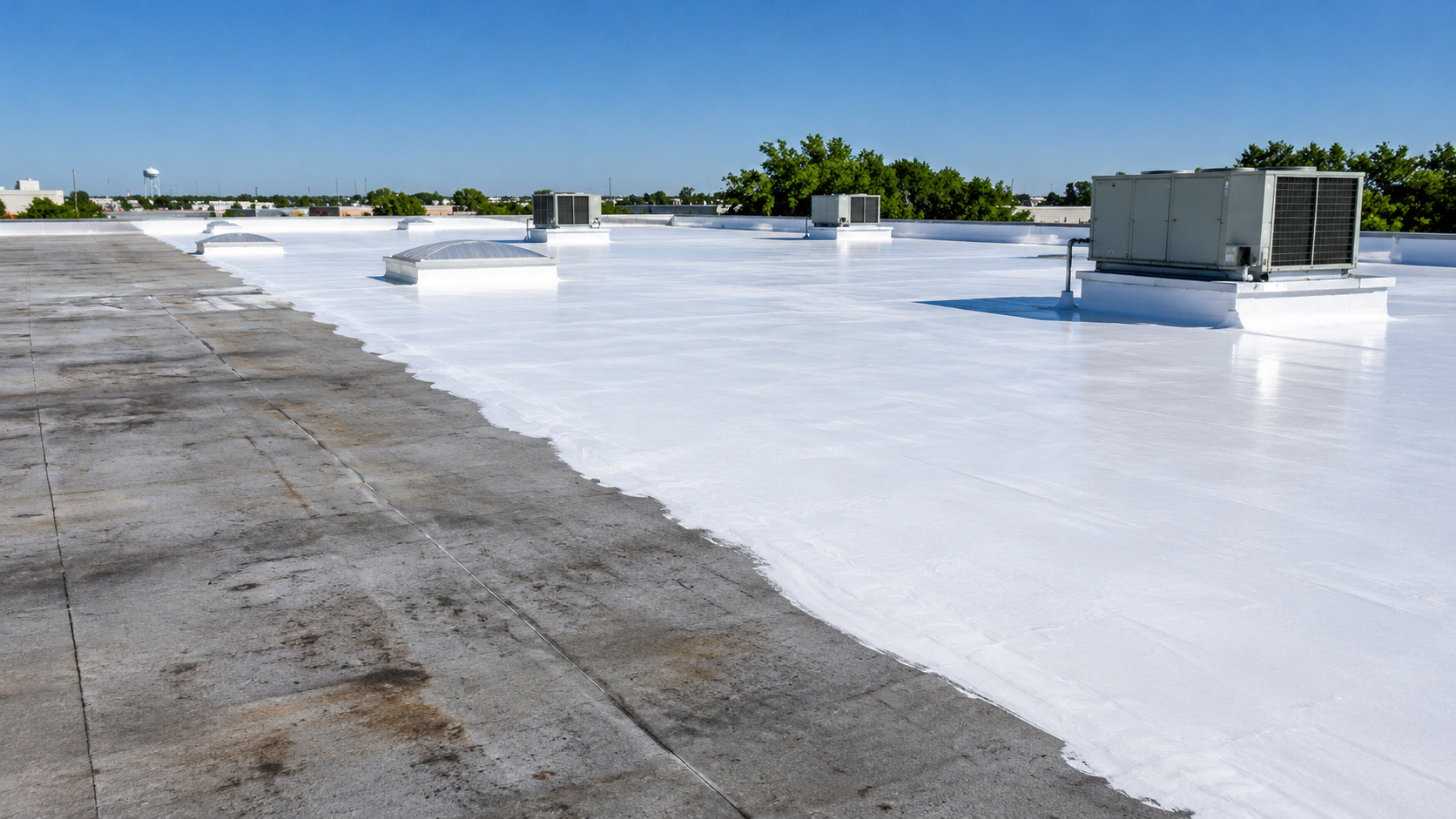
- Restoration. The existing membrane is cleaned and repaired, with seams and penetrations reinforced. Wet insulation is removed and replaced with dry. Then a fluid-applied coating goes over the whole surface. Silicone and acrylic are the commercial roof coatings used most often.
- Recover. A new roof covering is installed over the old one without removing it. That usually means a separation layer such as a cover board, followed by a new membrane such as TPO or modified bitumen. Building code calls this a roof recover.
- Replacement. Every layer comes off down to the deck. Damaged decking is repaired before new insulation and a new membrane go down. Code calls this a roof replacement, and you’ll also hear it called a tear-off.
Here is how the three compare side by side.
| What to compare | Restore | Recover | Replace |
|---|---|---|---|
| What happens | A coating goes over the existing roof | A new membrane goes over the existing roof | Everything comes off down to the deck |
| Installed cost | Typically the lowest | In the middle | Typically the highest |
| Years of service to plan around | 10 to 20, tied to the coating warranty | 15 to 20 | 20 to 30 for most membranes |
| Manufacturer warranty | Coating system warranty, commonly 10 to 20 years | System warranty, commonly up to 20 years | System warranty, commonly 10 to 30 years |
| Counts as a roof layer under code | No | Yes. It is the one recover code allows | No. The count starts over |
| Insulation upgrade required by energy code | No | No | Yes, where insulation sits above the deck |
| What rules it out | Wet insulation across much of the roof, a failing deck, or seams failing throughout | A water-soaked roof, two roofs already in place, or a structure that can’t carry the weight | Nothing. It is the option left when the others don’t qualify |
| What the next project can be | Recoat, recover, or replace | A tear-off of both roofs | Restore or recover |
Treat the years in that table as planning ranges. They come from typical warranty terms and published service-life guidance, and the real figure for your roof depends on the system installed and how well it is maintained.
When does commercial roof restoration make sense?
Restoration makes sense when the roof is dry and the seams are sound, with a membrane that is worn at the surface but not failing underneath. In that condition, it is usually the lowest-cost way to extend the life of a commercial roof. The coating renews the layer that takes the sun and the weather, and it protects the repairs made beneath it. It can’t dry out wet insulation or fix a failing deck. Put a coating over wet insulation and the water stays trapped under it.
The only way to know which roof you have is to look below the surface. We cut core samples, small plugs taken through the roof to show what is underneath, before we recommend a coating. On larger roofs an infrared scan can map where the insulation is holding water. Isolated wet areas can be cut out and replaced during prep. Once wet insulation reaches about a quarter of the roof, replacing it piece by piece starts to cost as much as a tear-off, and restoration stops making sense.
Drainage decides which coating goes on. Silicone tolerates standing water, so it is the choice for roofs that pond after rain. Acrylic costs less and performs well on roofs that drain, but ponding water wears it down. Our guide to the five types of waterproofing coatings covers where each one works and where it falls short.
Two points about restoration tend to surprise owners. The first is that building code doesn’t count a protective coating as another roof layer, so a roof restored today can still be recovered years from now. The second is that the warranty is new but separate. Coating manufacturers commonly issue their own system warranties of 10 to 20 years, with longer terms calling for a thicker application. That coverage applies to the coating. It does not extend the warranty on the membrane underneath.
Coatings are also weather dependent. Acrylic needs about 50 degrees and rising to cure, and silicone about 40. Both need a dry roof, which makes fall one of the better application windows in North Texas.
When is a commercial roof recover the better option?
A recover fits when the membrane has reached the end of its life but everything beneath it is still dry and sound, and the building has only one roof on it. You get a new membrane and a new manufacturer warranty without paying to tear off and haul away the old roof. The building also stays covered while the work is done.
Building code sets the limits. Section 1512 of the International Building Code does not permit a recover where the existing roof is water soaked or too deteriorated to serve as a base. It also rules one out where the roof already has two or more applications of roof covering. In plain terms, a building gets one recover. If yours has already had one, the next project is a tear-off of both roofs.
That is why a recover starts with a moisture survey. Wet areas found by infrared scan and confirmed with core cuts are removed and replaced before the new roof goes on. Manufacturers commonly require that survey before they will warrant a recover. Their warranties on recover systems typically run up to 20 years.
A recover also avoids a cost that a replacement can’t. Under the International Energy Conservation Code, a roof recover is exempt from the insulation upgrade that a tear-off triggers. That cuts both ways. You save on insulation now, and you keep the insulation value the building already has, along with the energy bills that come with it.
Two things are worth settling before you commit. The structure has to be able to carry the weight of a second roof, and an engineer may need to confirm that it can. You should also know what a recover sets up, because the project after it removes two roofs instead of one.
When is a full roof replacement the right call?
A full commercial roof replacement is the right call when the roof fails the tests the other two options depend on. That means wet insulation across much of the roof, a deteriorating deck, seams failing throughout the membrane, or two roofs already in place. It is also the only option that lets you fix what is under the membrane.
A tear-off exposes the deck, so damage gets found and repaired instead of covered over. Drainage can be corrected with tapered insulation that slopes water toward the drains. The energy code also requires the new insulation to meet current levels wherever it sits above the deck. In the DFW climate zones that means R-25 of continuous insulation. The figure is the same under the Texas statewide energy code and the 2021 edition that cities such as Dallas and Grand Prairie have adopted. Roofs built under earlier codes often have less.
So the price is the highest of the three, and it buys things the others can’t. Manufacturer system warranties on a new roof commonly run 10 to 30 years, and the building ends up better insulated. The layer count also starts over, which puts restoration and recover back on the table decades from now. Our post on what a commercial roof replacement costs walks through what moves that number.
One exception is worth knowing. If your roof deck is lightweight insulating concrete, the insulation is cast into the deck itself. When that deck is dry and in good shape, a re-roof removes the membrane and leaves the insulation where it is. Our explainer on how LWIC roof decks work covers why.
The KPost Advantage Program covers an annual roof assessment with a 5-year budget forecast. Manufacturers recommend or require periodic inspections to keep a warranty valid, so count that upkeep in the cost-per-year math for any option.
How do you compare the three options by cost per year?
Divide what each option costs by the years of service it buys. Cost per year is the installed price, plus the upkeep needed to keep the warranty valid, divided by the number of years you can reasonably count on. That puts a low price with a short life and a high price with a long life on the same scale.
The arithmetic is simple. A $300,000 project that buys 10 years costs $30,000 a year. A $500,000 project that buys 20 years costs $25,000 a year. The larger check is the less expensive roof. Those are round numbers to show the math, not pricing for any of the three options. Your numbers come from proposals written for your building.
Four adjustments keep the comparison honest.
- Count the years you can document. Use the warranty term or a conservative service life rather than the best case in a brochure.
- Price the project after this one. A restored roof can still be recovered. A recovered roof has to be torn off two layers deep next time. A replaced roof can be restored or recovered later. The cheaper option today can set up a more expensive one down the road.
- Add what the proposal leaves out. That includes the energy cost of keeping older insulation and the inspections that keep a warranty in force. On an occupied building, add the disruption a tear-off brings to tenants.
- Match the term to how long you’ll own the building. If you plan to sell in five years, a 30-year roof may never pay you back. A roof with a documented condition and a warranty in force is still easier to sell than one a buyer has to guess about, so ask whether the warranty transfers.
Cost per year is a first screen. If your team discounts future dollars, run the same proposals through your own model, because putting off a large capital project has value too. Ask your CPA how each option is treated on the books as well. Restoration work may be expensed as maintenance while a full replacement is generally capitalized, and that difference can change the after-tax comparison.
How does this decision fit into next year’s roof budget?
Start with the roof’s condition, then write the number. The findings from a moisture survey and core cuts decide which of the three options are still open and how long each should last. A budget line set without them is only a placeholder. If the roof is going into next year’s capital plan, the assessment is the first thing to schedule.
It also helps to start early. A common rule is to put a roof into the capital plan once it has used about 70 percent of its expected service life. For a roof expected to last 25 years, that is year 17 or 18. Our guide to how long a commercial roof lasts has planning ranges by roof type. Starting that early leaves room to restore or recover while the roof still qualifies. Wait until leaks force the decision, and the lower-cost options may no longer be open.
This is where the KPost Advantage Program comes in. It is our version of a preventative maintenance agreement, and budgeting is part of what you receive when you sign up. That turns the roof into a planned line item instead of a surprise.
Frequently asked questions
Get your options priced before the budget closes
You can’t tell which option an aging roof needs from the surface, and a single proposal won’t tell you either. Ask which of the three your roof still qualifies for and get those priced side by side, with the moisture data behind them. Then compare the cost per year.
KPost Company has handled commercial roofing across Dallas Fort Worth since 2004, including restoration, recover, and replacement work. If a roof is on your list for next year, contact our team and we’ll assess its condition and lay out the options it qualifies for.
Code references are to the International Building Code and the International Energy Conservation Code as published and are current as of October 2026. Cities adopt these codes on their own schedules and with local amendments, so the building official has the final say on any project. Service life and warranty terms vary by manufacturer and by system. The dollar figures in this article illustrate the arithmetic only and are not pricing. Nothing here is tax advice.
This video covers what the KPost Advantage Program includes:

