

Key Takeaways
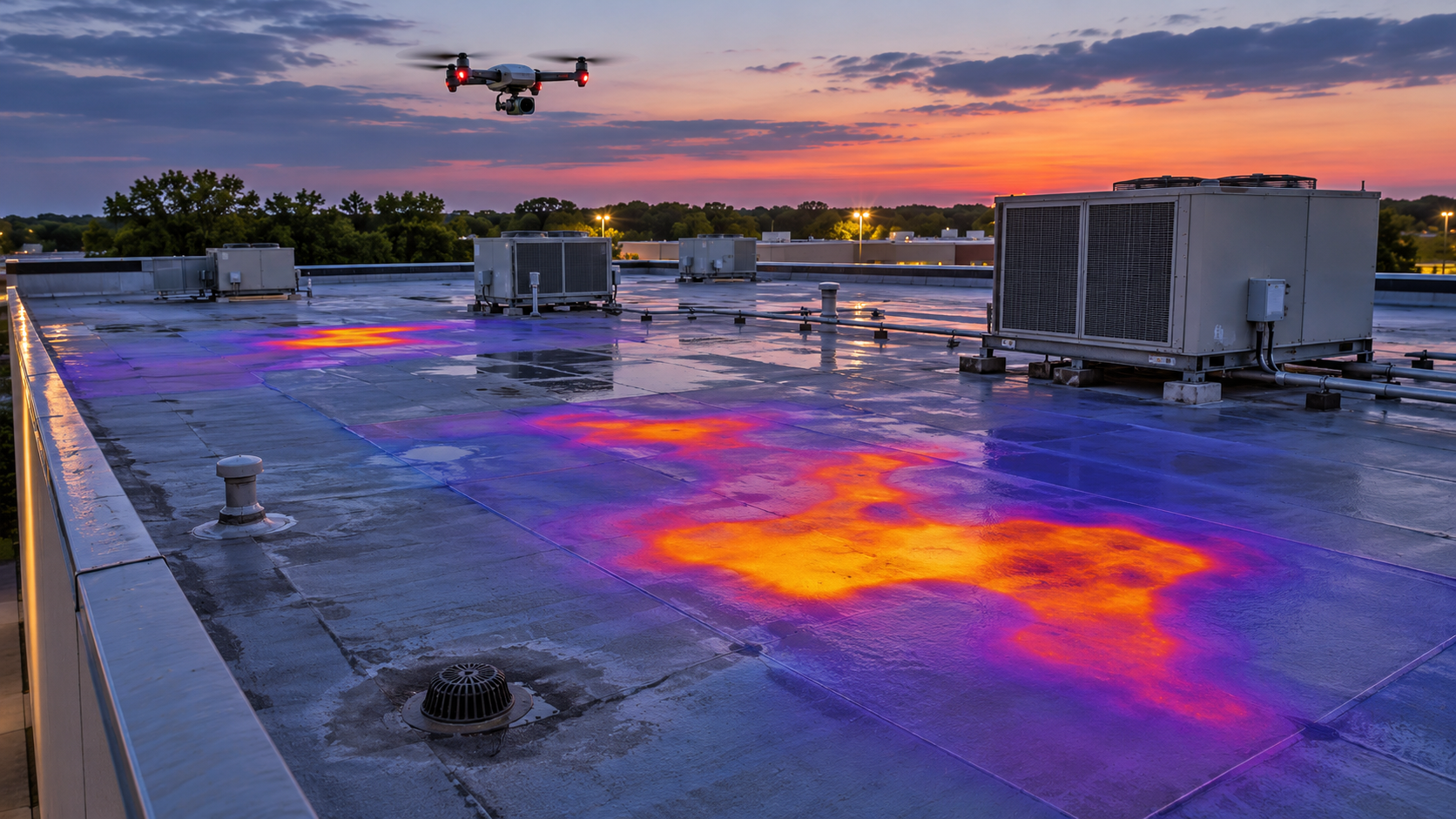
- An infrared survey maps wet insulation without opening the roof. Wet insulation holds the day’s heat longer than dry insulation does, so it shows up warm on a thermal camera after sunset. What you get back is a map of where water is sitting under the membrane and how far it has spread.
- The scan needs the right night. ASTM C1153, the standard practice for this work, calls for no appreciable rain in the 24 hours before the survey and wind under 25 km/h, which is about 15 mph. Most surveys start roughly an hour after sunset.
- A drone scans the whole roof system in one session. KPost uses drone thermal scanning on large properties, so the survey is not limited to the area around a leak. You get the full scope of the building in far less time than walking the roof used to take.
- A thermal image is a lead, and a core sample is the proof. The camera reads temperature, and other things besides water can look warm. ASTM C1153 requires the findings to be verified with core cuts, and NRCA’s reroofing guidance makes the same point.
- The wet area sets the scope and the budget. The International Building Code does not permit a recover over a water-soaked roof, so wet insulation has to come out either way. The survey tells you whether that means a few marked sections or the entire roof, before anyone prices a tear-off.
An infrared roof moisture survey, also called an infrared roof inspection or a thermal roof scan, is a nighttime scan that shows where the insulation under a low-slope roof membrane is holding water, without cutting the roof open first. You need one when a roof keeps leaking after repairs, or when nobody can tell you its history. You also need one before a recover or a full replacement gets priced, because how much insulation is wet, and where, decides which options are still on the table.
A lot of roof budgets get written from the surface. What sits under the membrane is assumed, and the assumption tends to run one of two ways: the whole roof has to go, or one more patch will handle it. A moisture survey replaces both guesses with a map. Below is how the scan works, what it needs to be accurate, where drone thermal scanning fits on a large building, and how the results turn into a scope you can take to a budget meeting.
How does an infrared scan find wet insulation under a roof membrane?
A thermal imaging camera reads surface temperature. It cannot see water. On a sunny day the whole roof heats up, and after sunset the dry areas give that heat back quickly. Insulation that has soaked up water holds the heat longer, because water stores far more heat than dry insulation board does. For a few hours the wet areas sit warmer than the roof around them, and the camera shows that difference as a pattern on the surface.
The practice is governed by ASTM C1153, Standard Practice for Location of Wet Insulation in Roofing Systems Using Infrared Imaging. Its current edition dates to 2023. The standard covers surveys done on foot as well as from the air, and it applies to roofs where the insulation sits above the deck and directly under the waterproofing, which is how most low-slope commercial roofs are built.
A warm reading is only a starting point. Heat exhausted from rooftop equipment can look the same as wet insulation, and so can a section that sat in full sun while the rest of the roof was shaded. That is why the standard requires the findings to be verified before anyone acts on them.
When does a commercial roof need a moisture survey?
A commercial roof needs a moisture survey any time a decision depends on what is under the membrane. In practice that comes down to a short list of situations.
- The same area keeps leaking. When repairs in one section do not hold, water has usually spread through the insulation below. A scan shows how far it has gone.
- The roof has a soft or sinking spot. Wet insulation loses its stiffness and compresses, which leaves a low area that holds water. If you have a sinking spot in your roof, we can scan it and check for moisture under and around it.
- A coating is being considered. A commercial roof coating applied over wet insulation seals the water in, so the insulation has to be confirmed dry first.
- A recover or replacement is about to be priced. Wet insulation found after the old roof comes off is one of the most common sources of change orders. A survey at the bidding stage puts it in the original number.
- A purchase or a warranty deadline is coming. A survey before closing on a building, or before a roof warranty expires, documents the condition while there is still time to act on it.
The install date will not tell you any of this. Our post on how long a commercial roof lasts gives planning ranges by membrane type, and a survey shows where your roof actually sits inside them. A visual inspection still comes first, and our commercial roof maintenance checklist covers what to look for from the surface. The survey picks up where a visual walk stops.
What conditions does an accurate infrared roof inspection need?
An accurate survey needs a dry roof, a sunny day behind it, a calm evening, and darkness. ASTM C1153 puts numbers on most of that. There should be no appreciable precipitation in the 24 hours before the survey, and wind has to stay under 25 km/h, about 15 mph. The roof surface also has to be free of ponded water and debris. Most surveys run from about one hour after sunset until sunrise.
Each condition protects the temperature difference the camera depends on. Rain cools the membrane and leaves surface water that hides what is underneath, and wind strips heat off the whole roof until the contrast flattens out. Heavy cloud cover is a different problem, because the roof never takes on enough heat to begin with. After an overcast day, the standard only supports a survey if it has been at least 10 degrees Celsius, or 18 degrees Fahrenheit, colder outside than in the space under the roof deck for most of the previous 24 hours.
In Dallas Fort Worth, long runs of hot, clear days are common from late spring into fall, so solar heating is seldom the obstacle. Rain inside the 24 hour window and gusty evenings are the conditions to watch. Fall is a practical time to schedule a survey, with summer heat behind the roof and next year’s budget still open.
Why scan a large commercial roof with a thermal drone instead of walking it?
A drone carries the thermal camera above the roof and looks straight down, so it can capture the full roof system in one session. On a large property, that gives you the full scope of the building instead of a spot check. KPost uses drone thermal scanning for exactly that reason. The scan is not limited to the area around one leak, and it takes far less time than walking the same roof with a handheld camera.
The straight-down view is the advantage. A handheld camera looks across the surface at a low angle, and the operator has to walk a tight pattern to cover every square foot. From above, the whole field is imaged at the same angle, so wet areas show up in their true shape and can be measured against a scaled drawing of the roof. Fewer hours of foot traffic on an aging membrane is a benefit too.
ASTM C1153 recognizes aerial surveys alongside walk-on surveys and sets a resolution requirement for each. A walk-on survey has to pick out a wet area as small as 0.15 meters on a side, about 6 inches. An aerial survey has to resolve 0.3 meters, about a foot. That is fine detail for a roof measured in acres. Either way, someone still goes up to verify what the camera flagged.
Flights for business use fall under FAA Part 107. Night flights require anti-collision lighting visible for at least 3 statute miles, and large parts of Dallas Fort Worth sit inside controlled airspace around DFW International and Dallas Love Field, where a drone needs FAA authorization before it takes off. Planning the survey around those rules is part of the job.
How do infrared, nuclear, impedance and core sampling methods compare?
Infrared is the fastest way to screen an entire roof. Nuclear gauges and electrical impedance scanners read moisture in places where infrared struggles, and core sampling is the physical check that confirms what any of the instruments found. A complete survey pairs one scanning method with a small number of cores.
| Method | What it detects | Roofs it suits | Disruption | Typical use |
|---|---|---|---|---|
| Infrared scan (ASTM C1153) | Surface temperature differences left by wet insulation after sunset | Insulated low-slope roofs with an exposed membrane. Weaker over stone ballast and on highly reflective surfaces | None to the roof. Night work that depends on weather | Screening the whole roof and mapping wet areas |
| Nuclear gauge (ANSI/SPRI/IIBEC NT-1) | Hydrogen in the roof, read as relative counts on a grid, typically 5 to 10 feet apart | Roofs that infrared reads poorly, including reflective membranes. Not used over metal roof systems | None to the roof. Daytime work by trained operators | Backing up or replacing infrared where it is inconclusive |
| Electrical impedance scanner (ASTM D7954) | Comparative moisture content, read through the membrane by its electrical response | Nonconductive membranes such as TPO and modified bitumen. Not suited to black EPDM or foil-faced materials | None to the roof. Daytime work | Tracing the edge of a wet area and checking spots a scan flagged |
| Core sample | The actual layers of the roof and the moisture in each one | Any roof | A small cut through the membrane and insulation, patched afterward | Verifying the instruments and measuring moisture content by weight |
Every instrument has blind spots. Under the infrared standard, stone ballast and pavers mute the thermal pattern, and highly reflective surfaces such as aluminized coatings can make an infrared survey impractical. Wet-applied materials are a separate case. The standard describes lightweight concrete insulation as difficult to survey, so on a roof built over lightweight insulating concrete, plan on cores and a second method to back up the scan.
So a survey should never end with the thermal image. ASTM C1153 requires infrared findings to be verified with core cuts, or with cores combined with moisture meter probes. NRCA’s reroofing guidance makes the same point: nondestructive surveys are useful for finding wet insulation, and test cuts should confirm what they find. A core is a plug cut through the membrane and insulation down to the deck. It shows how many roof systems are in place and what the insulation is, and it settles whether that insulation is wet. Then it gets patched.
The cores are usually few, which matters on buildings where opening the roof is a last resort, data centers among them. Nearly all of the investigation happens without a cut.
What should a roof moisture survey report contain?
A usable report lets someone who was never on the roof see where the wet insulation is and how that was confirmed. ASTM C1153 spells out what a survey report has to include. The main items make a good checklist when you are comparing proposals:
- A scaled roof drawing or aerial image with every wet area marked
- Representative thermal images of the areas flagged
- The date and time of the survey
- The location of each core or probe and what it showed
- The makeup of the roof as found in the cores
For budgeting, ask for one more number: the wet area in square feet, broken out by roof section. The standard does not require it. It is the figure a capital request gets built on.
That package is the evidence a capital request needs. It also becomes the baseline for the next survey, so you can see whether a wet area has grown. If the building is under a preventative maintenance agreement, the survey belongs in the same file as the inspection reports and the repair history.
How do the survey results decide between repair and replacement?
The results sort the roof into dry areas you keep and wet areas you remove. When the wet insulation is limited to a few marked sections, those sections can be cut out and rebuilt while the rest of the roof stays in service. When it is spread across the roof, replacement becomes the practical answer. In both cases you are pricing a known quantity.
A dry roof with a worn surface may only need restoration. A roof with isolated wet areas is usually a commercial roof repair: the wet insulation is cut out and replaced, then the section is tied back into the existing membrane. This is how a survey helps you budget. You can see whether you need a full replacement or only certain areas addressed, which can save money compared with tearing off a roof that is mostly dry.
A recover, where a new roof is installed over the old one, has a hard limit. The reroofing section of the International Building Code, the model code that Dallas and Fort Worth both adopt with local amendments, does not permit a recover where the existing roof is water-soaked. It also rules one out where the roof already has two or more roof coverings in place. In the 2021 edition that language is in Section 1512.2.1.1. NRCA takes the same position and does not recommend installing a recover roof system over wet insulation. Local amendments vary, so confirm the rule for your address before a recover is priced.
If the survey does point to a tear-off, the work carries forward. It becomes the starting scope for the commercial roof installation that follows, with the wet areas and the number of existing roof systems already documented.
Frequently asked questions
Scan the roof before you set the budget
Pricing a tear-off without a moisture survey means guessing at the largest number in the job. Patching a roof that is wet underneath is the same guess in the other direction. A survey takes the guess out of both.
KPost Company uses drone thermal scanning to survey full roof systems as part of its commercial roofing work across Dallas Fort Worth. If your roof has a leak history or a replacement decision coming up, contact our team. We will scan the roof and show you what the results mean for your budget.
Survey conditions and verification requirements cited here are drawn from ASTM C1153, ASTM D7954, ANSI/SPRI/IIBEC NT-1, the 2021 International Building Code and FAA Part 107, as published at the time of writing in October 2026. Standards and codes are revised, and local amendments apply. The right survey method for a specific roof depends on its construction and condition and should be confirmed with a qualified roofing professional.

